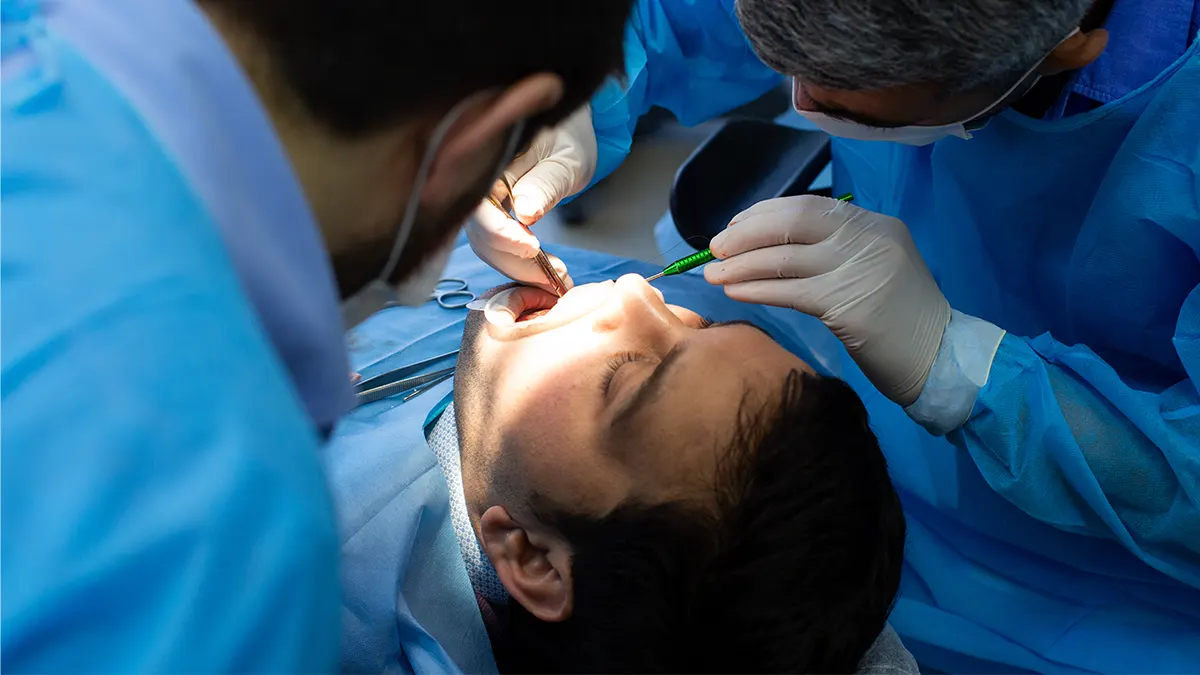
What Is Oral and Maxillofacial Surgery?
Oral and maxillofacial surgery covers conditions of the teeth, jawbones and surrounding soft tissues that require surgical intervention. It spans a wide range of procedures, from routine extractions and impacted tooth surgery to cyst and tumour removal and bone preparation prior to implant placement.
The majority of these procedures are carried out safely under local anaesthetic in a clinical setting. For anxious patients, or where several lengthy procedures are planned, sedation options can be considered.
Impacted Tooth Removal
The most frequently performed surgical procedure is the removal of impacted wisdom teeth. When there is insufficient room in the jaw, wisdom teeth either erupt partially or remain completely within the bone. Bacteria accumulate beneath the gum flap covering a partially erupted tooth, producing recurrent inflammation known as pericoronitis.
Extraction is not always indicated. There is no reason to remove a wisdom tooth that has erupted fully, sits in a functional position and can be cleaned properly. Removal is advised where there is recurrent infection, decay in the wisdom tooth or the molar in front of it, cyst formation around the crown, or pressure on the adjacent teeth.
Before surgery, panoramic radiography — and where necessary three-dimensional CT imaging — is used to assess the tooth''s relationship to the inferior alveolar nerve in the lower jaw and to the sinus cavity in the upper jaw. This assessment is the essential step in minimising the risk of complications.
Cyst and Lesion Surgery
Cysts developing within the jawbones frequently produce no symptoms and are often discovered incidentally on routine radiographs. As they enlarge they resorb the surrounding bone and require surgical removal, with the excised tissue sent for pathological examination. Because early lesions can be treated with a far smaller procedure, regular radiographic review is decisive here too.
Pre-Implant Surgical Procedures
Where teeth have been missing for a long time, the jawbone loses both height and width. If there is insufficient bone for an implant, bone grafting is used to rebuild the missing volume. In the posterior upper jaw, where the sinus cavity has expanded downwards, a sinus lift creates the bone height required for implant placement.
Socket preservation carried out at the time of extraction also helps maintain bone volume for a future implant, and can avoid the need for larger grafting procedures later on.
Postoperative Care
Applying cold to the area intermittently during the first 24 hours markedly reduces swelling, which typically peaks on the second day before subsiding. The mouth should not be rinsed vigorously on the first day, as this can dislodge the clot at the surgical site and lead to a painful dry socket.
Warm, soft foods are recommended in the first few days, while hot drinks and smoking should be avoided. Smoking is the most significant factor impairing wound healing and increasing the risk of infection. Painkillers, and antibiotics where prescribed, should be taken as directed, and the appointment for suture removal should be kept.