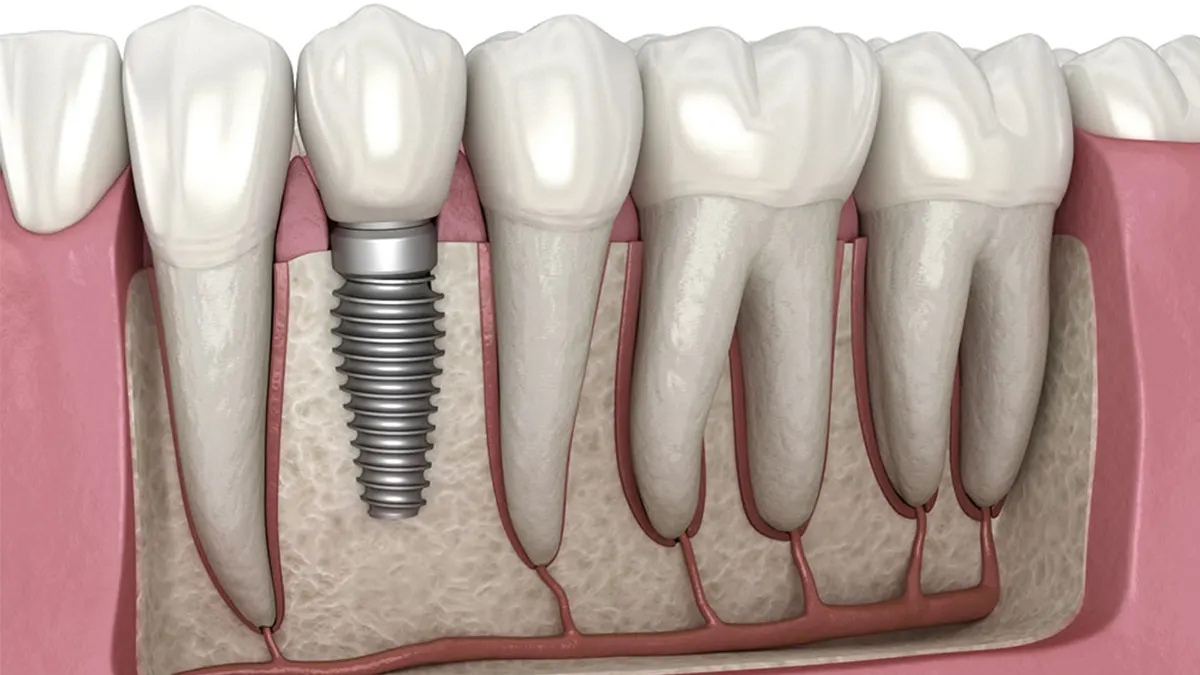
What Is a Dental Implant?
A dental implant is a screw-shaped fixture, made from titanium or a titanium alloy, that is placed into the jawbone to take the place of a missing tooth root. Titanium is used because living bone bonds directly to its surface — a process known as osseointegration. Once that bond has formed, the implant transmits chewing forces to the jawbone exactly as a natural root would. With a crown fitted on top, the result is difficult to distinguish from a natural tooth in both appearance and function.
The greatest advantage of an implant is that it stands alone. A conventional bridge requires the healthy teeth on either side of the gap to be reduced in size, whereas an implant leaves them completely untouched — preserving more of your natural tooth structure for the long term.
Who Is Suitable for Implant Treatment?
Almost any adult in reasonable general health, with healthy gums and adequate jawbone volume, is a candidate. Implants are used to replace a single tooth, several adjacent teeth, or to support a full arch of teeth in a completely edentulous jaw.
When a tooth has been missing for a long time, the surrounding bone begins to resorb. If bone volume is insufficient, procedures such as bone grafting or sinus lifting can rebuild a suitable foundation before the implant is placed. Uncontrolled diabetes, heavy smoking, certain medications affecting bone metabolism and untreated gum disease all impair healing, so a detailed medical history is taken beforehand and, where necessary, we liaise with your physician.
Because jaw growth must be complete, implants are not normally placed in adolescents. Treatment is usually planned from around age 17 in girls and 19 to 20 in boys.
What Does Treatment Involve?
The process begins with a thorough examination and three-dimensional CT imaging. This shows bone thickness and density, together with the exact position of nerves and sinus cavities, allowing the angle and depth of the implant to be planned digitally before any surgery takes place.
Placement is carried out under local anaesthetic and typically takes 30 to 60 minutes for a single implant. The procedure itself is painless, and the mild tenderness that may follow is easily managed with simple painkillers. For anxious patients, or where multiple implants are planned, sedation can also be considered.
Integration with the bone takes an average of two to three months in the lower jaw and three to six months in the upper jaw. A temporary tooth is provided throughout this period, so you are never left with a visible gap. Once integration is complete, impressions are taken and a permanent zirconium or porcelain crown is fitted.
Implant-Supported Restoration Options
A single missing tooth is restored with a single crown. Where several adjacent teeth are missing, two implants can support a fixed bridge, restoring a wider span with fewer implants. For a fully edentulous jaw there are two main approaches: a fixed prosthesis anchored on four to six implants, which the patient cannot remove, or an overdenture that clips onto the implants with stud-like attachments and can be taken out for cleaning. The right choice depends on available bone, your expectations and your oral hygiene habits, and is decided together.
Caring for Your Implant
Implants cannot decay, but the gum around them can become inflamed just as it does around natural teeth. This condition, peri-implantitis, destroys the supporting bone in the same way gum disease does and can ultimately cause implant loss. Brushing twice daily, cleaning between the teeth with interdental brushes or floss, and attending six-monthly check-ups are therefore an integral part of the treatment rather than optional extras.
Long-term studies show that well-maintained implants routinely serve for twenty years and beyond. Smoking is the single greatest factor reducing implant success; stopping, or at least significantly reducing, during treatment measurably improves the long-term outcome.